
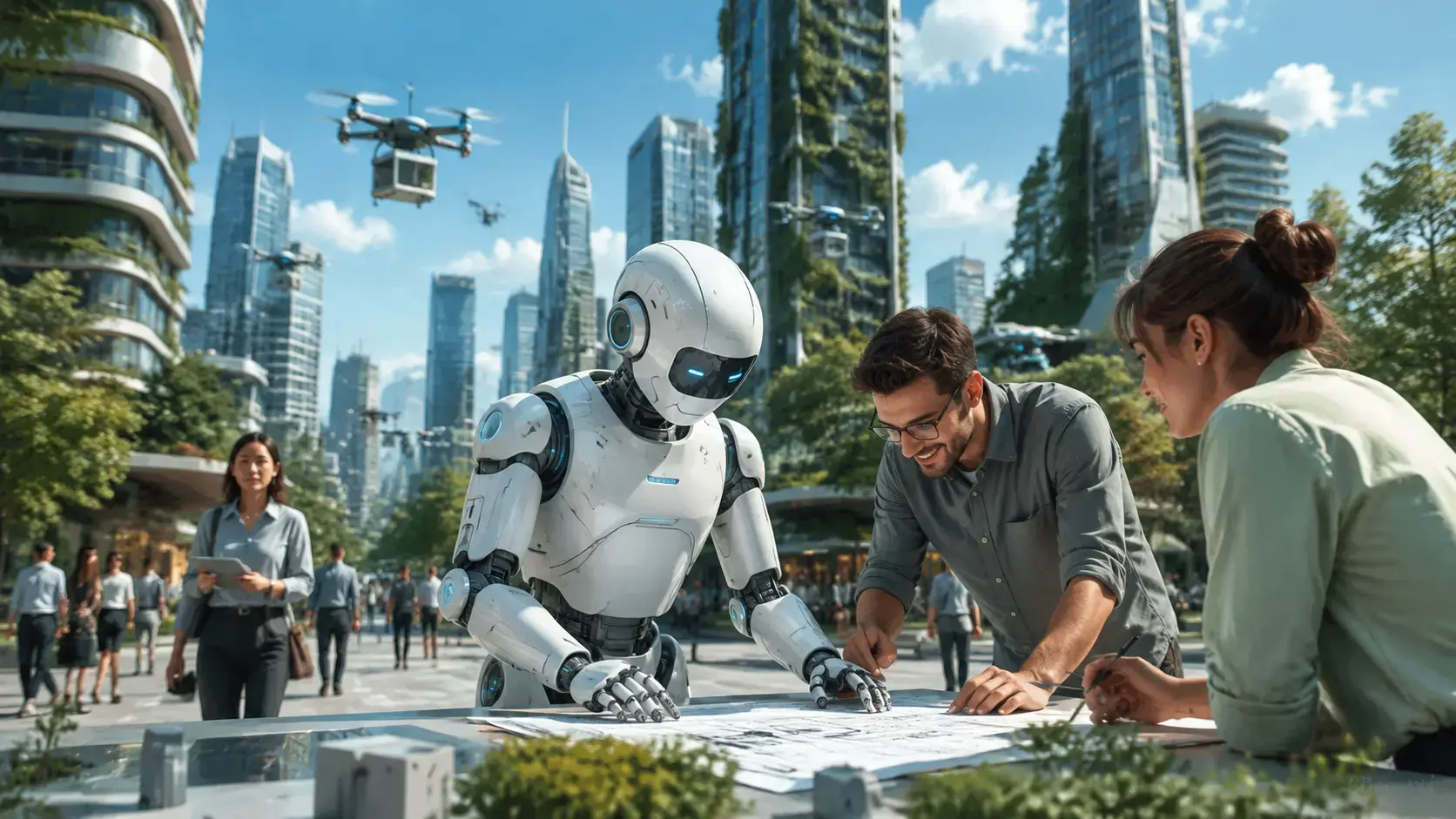
Picture a Tuesday morning in 2026. In a warehouse outside Berlin, a humanoid robot carefully lifts an oddly shaped box and sets it onto a conveyor. In a Seoul hospital, a wheeled robot delivers blood samples to the lab. And in your home, a small robot has already vacuumed the kitchen before you woke up. This is not science fiction - this is robotics today. From humanoid robots to autonomous mobile robots, machines have quietly entered everyday life. In this guide we explain the main types of robots, how they work, where they are used, and why the robotics market 2026 is one of the fastest-growing sectors in technology.
What Is Robotics? A Simple Definition
At its core, robotics is the science of building machines that can sense, decide, and act in the physical world. The field blends mechanical engineering, electronics, computer science, and artificial intelligence into a single discipline. A robot is not just a metal body - it is a loop of perception, decision, and movement, repeated many times per second.
Nearly every robot, from a simple vacuum cleaner to the most advanced humanoid, shares four building blocks:
- Sensors - cameras, lidar, and force sensors that let the robot perceive its surroundings.
- Actuators - motors and drives that work like muscles, turning electricity into motion.
- Control system - the onboard computer that translates goals into precise commands.
- AI software - the layer that interprets messy reality and decides what to do next.
Put simply: sensors are the eyes and skin, actuators are the muscles, the control system is the spinal cord, and AI is the brain. When these four work in harmony, a machine stops being an appliance and becomes a robot. And unlike a fixed automation machine, a true robot can react when the world surprises it.
Nearly every robot, from a simple vacuum cleaner to the most advanced humanoid, shares four building blocks:
- Sensors - cameras, lidar, and force sensors that let the robot perceive its surroundings.
- Actuators - motors and drives that work like muscles, turning electricity into motion.
- Control system - the onboard computer that translates goals into precise commands.
- AI software - the layer that interprets messy reality and decides what to do next.
Put simply: sensors are the eyes and skin, actuators are the muscles, the control system is the spinal cord, and AI is the brain. When these four work in harmony, a machine stops being an appliance and becomes a robot. And unlike a fixed automation machine, a true robot can react when the world surprises it.
The Main Types of Robots in 2026
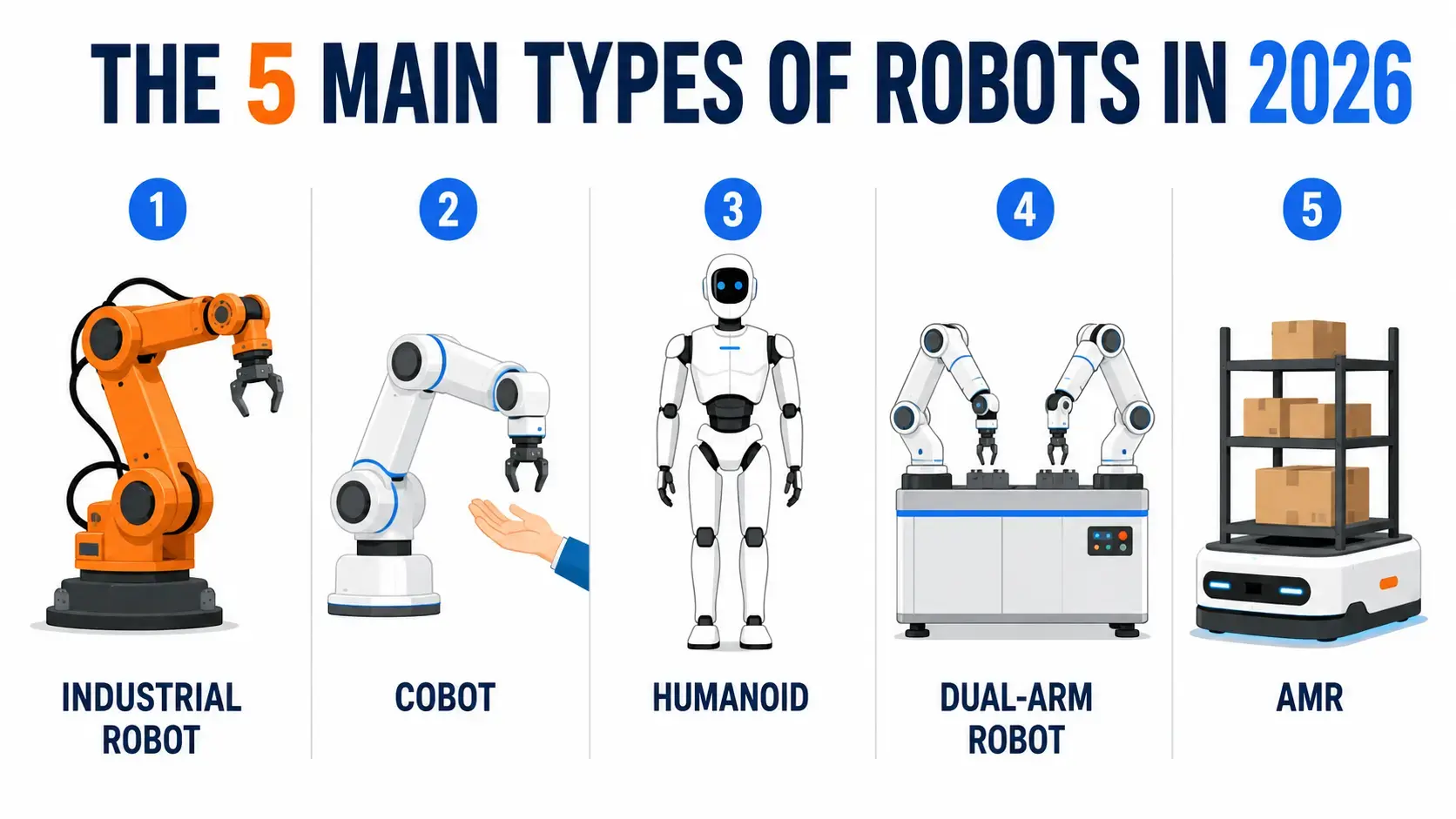
Not all robots look alike, and they are not built for the same jobs. Here are the five main types of robots shaping the industry in 2026.
Industrial Robots
The original workhorses of the field. Industrial robots are typically large robotic arms bolted to the factory floor, performing welding, painting, assembly, and palletizing with superhuman speed and precision. They usually work inside safety cages, separated from people, and can run around the clock for years. Millions of industrial arms are active worldwide in 2026 - the quiet backbone of car and electronics manufacturing.
Collaborative Robots (Cobots)
Collaborative robots, or "cobots," are the friendly younger siblings of industrial robots. They are designed to work safely side by side with humans, without safety cages, using force limits, rounded edges, and advanced sensors to stop the instant they touch a person. Cobots take over repetitive tasks like screw driving, packaging, and machine tending, while people handle judgment and fine dexterity. They are especially popular with small and mid-sized manufacturers because they are relatively affordable and easy to program.
Humanoid Robots
The superstars of 2026. Humanoid robots - such as Tesla's Optimus, Figure's humanoids, and Boston Dynamics' Atlas - are built with a human-like body plan: two arms, two legs, a torso, and a head. Why human-shaped? Because our world is built for humans: stairs, doorways, workbench heights, and tools. A robot that shares our body can, in theory, use any space and any tool we can. Humanoids are still early, but they already walk factory floors, and billions of dollars of investment are pouring into making them practical.
Bimanual and Dual-Arm Robots
Some robots deserve their own category for one reason: they have two coordinated arms. Bimanual robotics focuses on machines that use two arms together the way humans do - one hand holding, the other working. These robots excel at assembly, packing, and handling soft or irregular objects. Many humanoids are effectively bimanual platforms on legs, while stationary dual-arm workstations are spreading through labs and factories.
Autonomous Mobile Robots (AMR)
The movers of the robot world. Autonomous mobile robots navigate warehouses, hospitals, and sidewalks using cameras, lidar, and digital maps - no rails, no wires, no drivers. In fulfillment centers, fleets of AMRs carry entire shelves to human pickers; on city streets, delivery robots bring groceries to your door. AMRs are the quiet success story of modern robotics: little drama, millions of useful kilometers every day.
Bimanual Robotics: Why Two Arms Change Everything
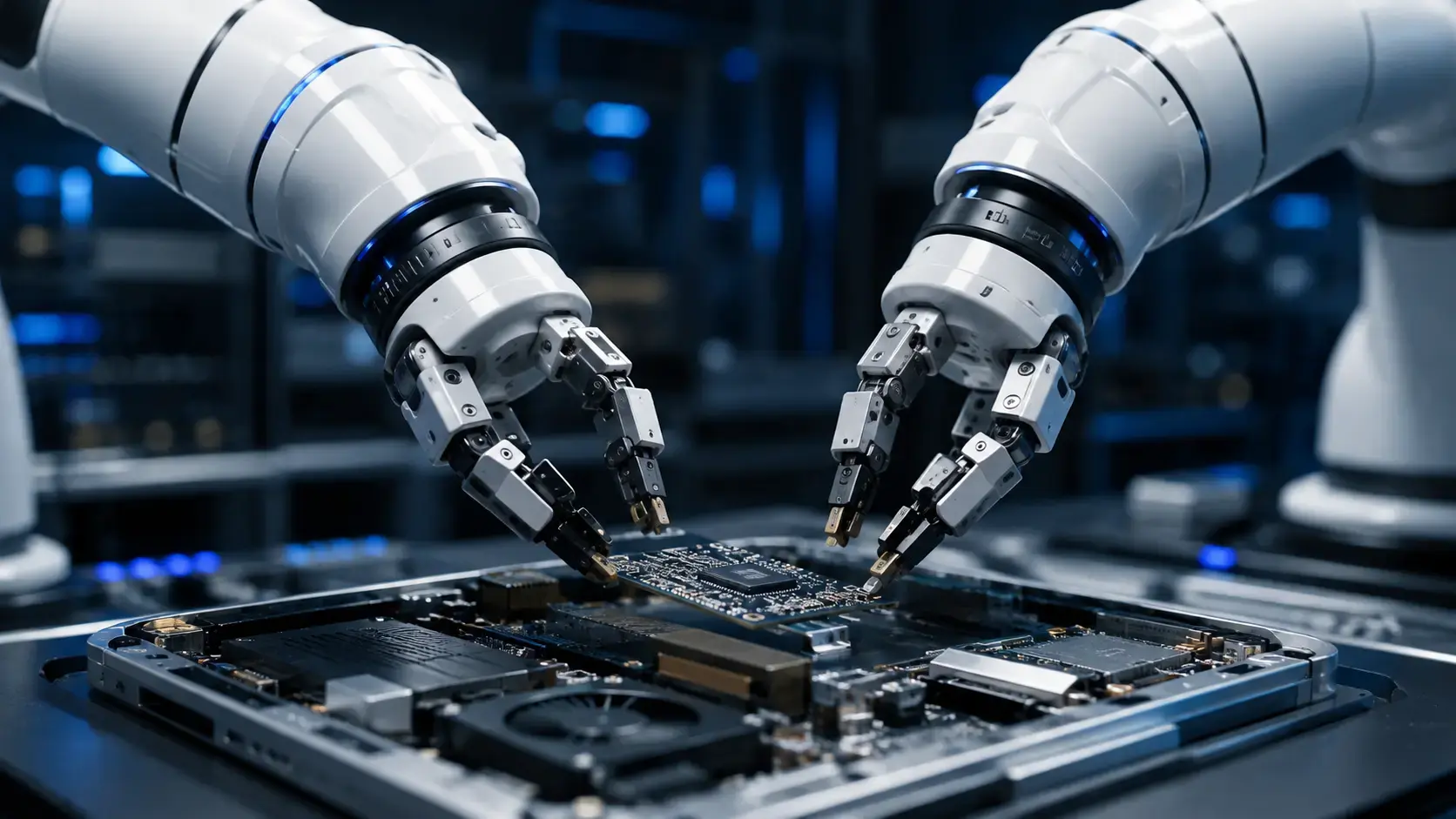
It looks simple because we do it without thinking: hold a bottle with one hand, twist the cap with the other. But for a robot, coordinating two arms is one of the hardest problems in engineering - and solving it is one of the biggest prizes in the field.
Why is it so hard? First, every added arm multiplies the degrees of freedom, and the number of possible movements explodes. Second, the arms must not collide with each other, with the object, or with a person standing nearby. Third, the robot has to plan not just motion but the division of roles - which arm stabilizes and which arm acts, sometimes switching roles mid-task.
Then there is touch. Bimanual tasks demand precise force control: grip an egg without cracking it, insert a connector without bending the pins. Modern dual-arm systems combine force sensors in the wrists and fingertips with AI models trained on thousands of real manipulation attempts, usually rehearsed first in simulation.
So what does this unlock? Almost everything we actually do with our hands:
- Assembling electronics, wiring harnesses, and small mechanisms
- Packing irregular, soft, or fragile items
- Laboratory work: pipetting, handling test tubes, sorting samples
- Household tasks: cooking, folding laundry, loading the dishwasher
- Using human tools in spaces designed for humans
This is why bimanual robotics has become one of the hottest research and startup fields of 2026. A one-armed robot automates a machine; a two-armed robot automates a human task. Master both arms, and a robot can step into millions of jobs designed for human hands.
Why is it so hard? First, every added arm multiplies the degrees of freedom, and the number of possible movements explodes. Second, the arms must not collide with each other, with the object, or with a person standing nearby. Third, the robot has to plan not just motion but the division of roles - which arm stabilizes and which arm acts, sometimes switching roles mid-task.
Then there is touch. Bimanual tasks demand precise force control: grip an egg without cracking it, insert a connector without bending the pins. Modern dual-arm systems combine force sensors in the wrists and fingertips with AI models trained on thousands of real manipulation attempts, usually rehearsed first in simulation.
So what does this unlock? Almost everything we actually do with our hands:
- Assembling electronics, wiring harnesses, and small mechanisms
- Packing irregular, soft, or fragile items
- Laboratory work: pipetting, handling test tubes, sorting samples
- Household tasks: cooking, folding laundry, loading the dishwasher
- Using human tools in spaces designed for humans
This is why bimanual robotics has become one of the hottest research and startup fields of 2026. A one-armed robot automates a machine; a two-armed robot automates a human task. Master both arms, and a robot can step into millions of jobs designed for human hands.
Where Robots Work Today
Robots have spread far beyond the car factory. Here is where they earn their keep in 2026:
- Logistics and warehouses - AMRs move goods across vast floors while robotic arms pick, pack, and palletize orders.
- Manufacturing - welding, painting, assembly, and camera-based quality inspection at superhuman consistency.
- Medicine and surgery - surgical robots give surgeons ultra-steady hands; hospital couriers deliver medication, linen, and samples.
- Agriculture - autonomous tractors, crop-monitoring drones, and robots that pick fruit or remove weeds plant by plant.
- Retail and hospitality - inventory-scanning robots in stores, plus robots that cook, brew coffee, and clean floors.
- Space and underwater exploration - rovers on Mars, robotic arms servicing satellites, and deep-sea inspection vehicles.
One pattern stands out: robots take the jobs that are dull, dirty, or dangerous - and increasingly, the jobs that are simply too precise, too heavy, or too tiring for people to do all day.
- Logistics and warehouses - AMRs move goods across vast floors while robotic arms pick, pack, and palletize orders.
- Manufacturing - welding, painting, assembly, and camera-based quality inspection at superhuman consistency.
- Medicine and surgery - surgical robots give surgeons ultra-steady hands; hospital couriers deliver medication, linen, and samples.
- Agriculture - autonomous tractors, crop-monitoring drones, and robots that pick fruit or remove weeds plant by plant.
- Retail and hospitality - inventory-scanning robots in stores, plus robots that cook, brew coffee, and clean floors.
- Space and underwater exploration - rovers on Mars, robotic arms servicing satellites, and deep-sea inspection vehicles.
One pattern stands out: robots take the jobs that are dull, dirty, or dangerous - and increasingly, the jobs that are simply too precise, too heavy, or too tiring for people to do all day.
AI + Robotics: When Machines Learn to Think
For decades, robots were blind executors: engineers programmed every movement by hand, and any surprise broke the routine. AI robotics changed the equation. Instead of being programmed for every case, modern robots are trained, the way people learn skills.
Three breakthroughs matter most:
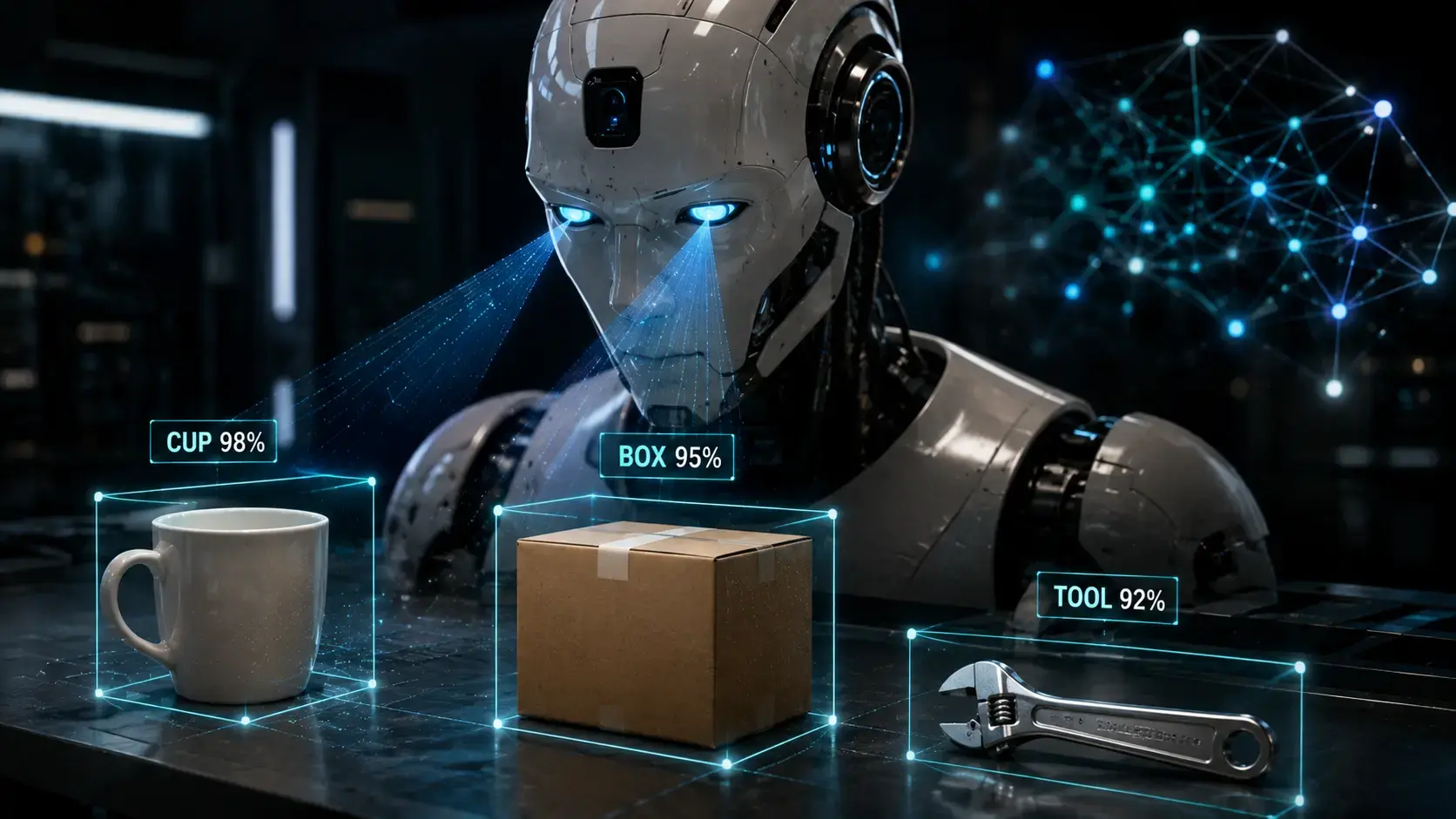
- Computer vision - neural networks let robots recognize objects, people, and obstacles in cluttered, real-world scenes.
- Machine learning - robots generalize from examples, handling items and situations they have never seen before.
- Reinforcement learning - robots rehearse in simulation millions of times, learning to walk, grasp, and recover from falls.
The newest wave is even more exciting: imitation learning. An engineer demonstrates a task - moving the robot's arms by hand or wearing motion sensors - and the robot learns from the demonstration, the way an apprentice learns from a master. Combine that with large "vision-language-action" models, and you can start giving robots instructions in plain language: "put the red part in the blue tray."
The result is a shift from rigid automation to flexible autonomy. A robot of 2026 does not just repeat one motion - it perceives, adapts, and improvises within its task. That is a fundamentally different machine.
Three breakthroughs matter most:
- Computer vision - neural networks let robots recognize objects, people, and obstacles in cluttered, real-world scenes.
- Machine learning - robots generalize from examples, handling items and situations they have never seen before.
- Reinforcement learning - robots rehearse in simulation millions of times, learning to walk, grasp, and recover from falls.
The newest wave is even more exciting: imitation learning. An engineer demonstrates a task - moving the robot's arms by hand or wearing motion sensors - and the robot learns from the demonstration, the way an apprentice learns from a master. Combine that with large "vision-language-action" models, and you can start giving robots instructions in plain language: "put the red part in the blue tray."
The result is a shift from rigid automation to flexible autonomy. A robot of 2026 does not just repeat one motion - it perceives, adapts, and improvises within its task. That is a fundamentally different machine.
The Robotics Market in 2026: Numbers and Trends
So how big is the robotics market 2026? By most analyst estimates, the global robotics market - hardware, software, and services combined - is now measured in the hundreds of billions of dollars, growing faster than the wider economy year after year.
Venture capital tells the same story. Robotics startups have been raising tens of billions of dollars annually, and humanoid companies attract the biggest checks: Figure AI's valuation of around $39 billion made it one of the most valuable startups on the planet despite limited revenue. Industrial robot installations keep setting records too, with Asia leading deployment.
Key trends to watch:
- Humanoids moving from viral demos to paid pilot projects in factories and logistics.
- Robots-as-a-Service (RaaS) lowering the entry bar - companies rent robots by the hour instead of buying them.
- New manufacturers pushing prices down and volumes up across every robot category.
- AI talent flooding into robotics from the software industry.
The takeaway: robotics is no longer a niche. It is becoming a general-purpose technology, like electricity or the internet - and general-purpose technologies reshape everything they touch.
Venture capital tells the same story. Robotics startups have been raising tens of billions of dollars annually, and humanoid companies attract the biggest checks: Figure AI's valuation of around $39 billion made it one of the most valuable startups on the planet despite limited revenue. Industrial robot installations keep setting records too, with Asia leading deployment.
Key trends to watch:
- Humanoids moving from viral demos to paid pilot projects in factories and logistics.
- Robots-as-a-Service (RaaS) lowering the entry bar - companies rent robots by the hour instead of buying them.
- New manufacturers pushing prices down and volumes up across every robot category.
- AI talent flooding into robotics from the software industry.
The takeaway: robotics is no longer a niche. It is becoming a general-purpose technology, like electricity or the internet - and general-purpose technologies reshape everything they touch.
The Future: What's Next for Robotics
Look toward the end of the decade, and a few clear trajectories emerge:
- Home robots - humanoids that fold laundry, load dishwashers, and tidy up; difficult, but the prize is enormous.
- Robots as a service - fleets managed remotely and billed per task, like cloud computing for physical work.
- Swarm robotics - many simple robots coordinating like ants to map, inspect, and build.
- Deeper human-robot collaboration - cobots evolving into true teammates that understand gestures and voice.
- Better brains - foundation models giving robots common sense about the physical world.
None of this happens overnight. Real-world reliability, safety certification, and cost still slow deployment down. But the direction is unmistakable: robots are moving from cages to corridors, from factories to homes, from tools to colleagues.
- Home robots - humanoids that fold laundry, load dishwashers, and tidy up; difficult, but the prize is enormous.
- Robots as a service - fleets managed remotely and billed per task, like cloud computing for physical work.
- Swarm robotics - many simple robots coordinating like ants to map, inspect, and build.
- Deeper human-robot collaboration - cobots evolving into true teammates that understand gestures and voice.
- Better brains - foundation models giving robots common sense about the physical world.
None of this happens overnight. Real-world reliability, safety certification, and cost still slow deployment down. But the direction is unmistakable: robots are moving from cages to corridors, from factories to homes, from tools to colleagues.
Building a Robotics Company? Your Brand Starts With a Name
The boom you just read about has a side effect: thousands of new robotics startups are founded every year, and every single one of them needs a name. In a crowded market, a clear, memorable domain is more than an address - it is the first signal of credibility to investors, customers, and journalists.
That is why specialized robotics domain names carry real value. A name that describes what you build - two arms, hauling, multi-robot control - instantly communicates your focus and captures the search traffic your future buyers already type in.
Naming a venture today? Consider category-defining names like BimanualRobotics.com, DualArmAI.com, or BimanualRobot.com. Building for logistics? HaulerRobotics.com and HaulRobot.comsay exactly what your machines do. And for the AI control layer, MultiArmRobot.com is a rare exact match.
Robotics is the defining technology of this decade - the place where artificial intelligence finally gets a body. Whether you are a student, an investor, or a founder, understanding robots today means understanding the economy of tomorrow. The robot revolution is just getting started, and every revolution needs names worth remembering. Start with the asset that anchors your brand: the name. Explore premium robotics domains on Ainame24 and claim yours before a competitor does.
That is why specialized robotics domain names carry real value. A name that describes what you build - two arms, hauling, multi-robot control - instantly communicates your focus and captures the search traffic your future buyers already type in.
Naming a venture today? Consider category-defining names like BimanualRobotics.com, DualArmAI.com, or BimanualRobot.com. Building for logistics? HaulerRobotics.com and HaulRobot.comsay exactly what your machines do. And for the AI control layer, MultiArmRobot.com is a rare exact match.
Robotics is the defining technology of this decade - the place where artificial intelligence finally gets a body. Whether you are a student, an investor, or a founder, understanding robots today means understanding the economy of tomorrow. The robot revolution is just getting started, and every revolution needs names worth remembering. Start with the asset that anchors your brand: the name. Explore premium robotics domains on Ainame24 and claim yours before a competitor does.