
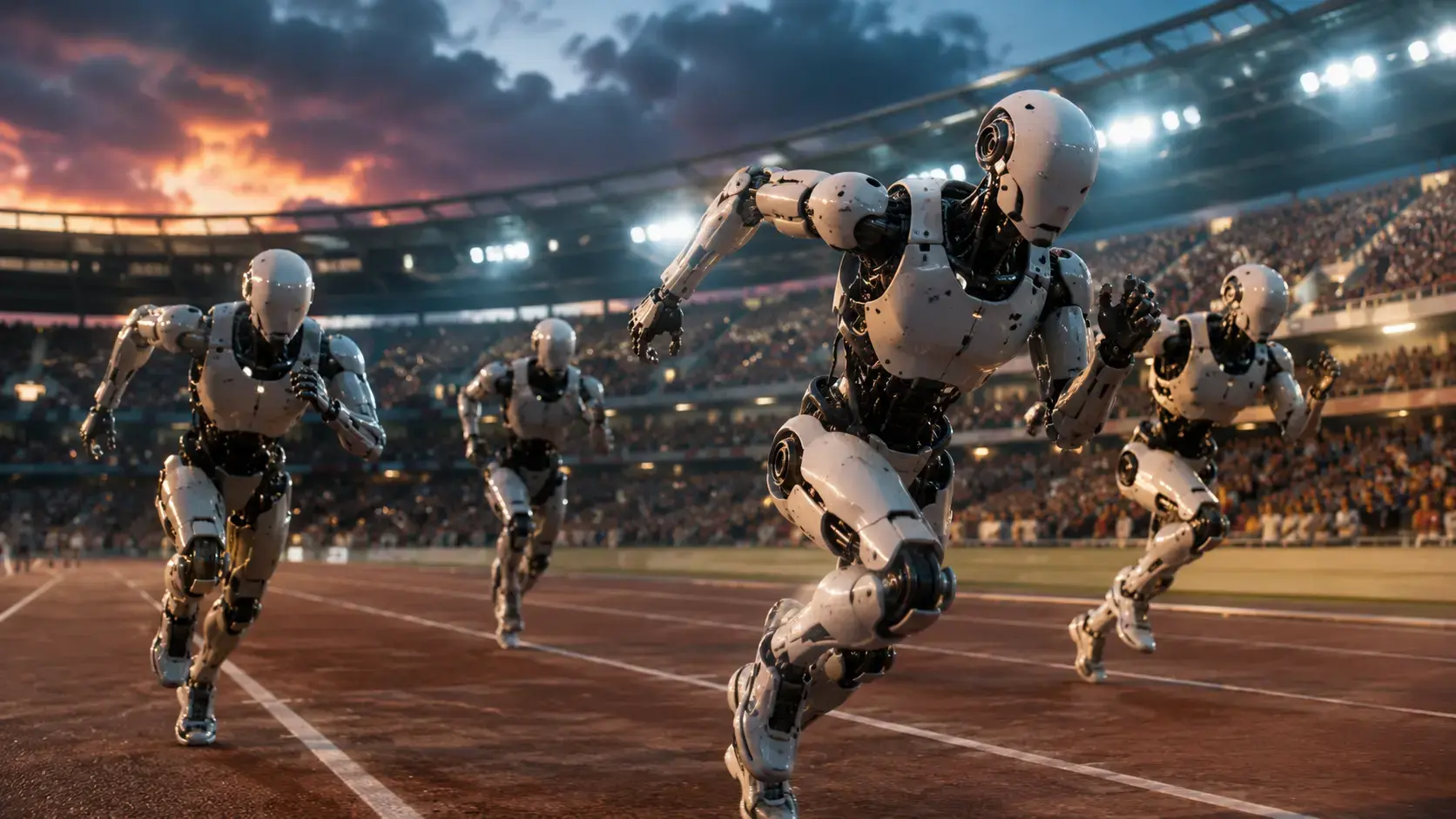
The stadium lights blaze over Beijing’s National Speed Skating Oval. Thousands of spectators lean forward, but they are not watching human athletes. They are watching humanoid robots. On the track, mechanical runners explode from the starting blocks. One stumbles, crashes to the synthetic surface, then pushes itself back up and keeps running. The crowd cheers louder than they would for any Olympic final.
This is the new reality of robot games in China - a spectacle that blends high-stakes sports, science fiction, and serious industrial policy. Let’s take a fictional example: imagine Chen, a 28-year-old engineer in the stands, watching a robot he helped program complete a 400-meter dash. His hands are clenched. This isn’t just a competition. It is a public, unforgiving examination of technology that will soon work in factories, homes, and hospitals.
This is the new reality of robot games in China - a spectacle that blends high-stakes sports, science fiction, and serious industrial policy. Let’s take a fictional example: imagine Chen, a 28-year-old engineer in the stands, watching a robot he helped program complete a 400-meter dash. His hands are clenched. This isn’t just a competition. It is a public, unforgiving examination of technology that will soon work in factories, homes, and hospitals.
The Robot Games Are Real: What Happens in China's Humanoid Arenas
This is not a controlled laboratory demonstration. The World Humanoid Robot Games are full-scale competitions where robot athletes run track events, play football, throw punches in boxing matches, and perform real-world tasks like sorting medications or handling factory materials.
The atmosphere crackles with tension. Engineers act as coaches, pacing nervously at the sidelines. Robots stumble, fall, and sometimes emit smoke. Yet, they also shatter human world records.
What separates these humanoid robot games from traditional robotics showcases is the raw public accountability. There is no hiding behind curated demos. A critical, often overlooked detail is the "Autonomy Weight Coefficient." In many events, robots operating fully autonomously receive full points, while those relying on human teleoperation are penalized with half the available score. This rule forces teams to solve genuine AI problems, not just remote-control tricks.
The atmosphere crackles with tension. Engineers act as coaches, pacing nervously at the sidelines. Robots stumble, fall, and sometimes emit smoke. Yet, they also shatter human world records.
What separates these humanoid robot games from traditional robotics showcases is the raw public accountability. There is no hiding behind curated demos. A critical, often overlooked detail is the "Autonomy Weight Coefficient." In many events, robots operating fully autonomously receive full points, while those relying on human teleoperation are penalized with half the available score. This rule forces teams to solve genuine AI problems, not just remote-control tricks.
A Short History: From Lab Demos to the Robot Olympics
The rise of robot sports in China robotics happened with stunning speed. The humanoid boom of 2023–2024 saw companies releasing machines that could run and recover from falls. But 2025 marked the turning point when robotics moved from private labs to public stadiums.
In April 2025, Beijing held its first humanoid robot half-marathon alongside a human race. About 20 robots entered. The best finished in 2 hours and 40 minutes, plagued by frequent falls and stumbles.
Just one year later, in April 2026, over 100 humanoid robots competed in the same event. Honor’s Lightning robot completed the 21-kilometer course in 50 minutes and 26 seconds, smashing the human world record of 57:20 held by Uganda’s Jacob Kiplimo. The improvement was staggering, driven by in-house liquid-cooling systems and advanced autonomous navigation.
Then came August 2025 and the first World Humanoid Robot Games. For three days, Beijing hosted 280 teams and over 500 robots across 26 events. Hangzhou-based Unitree Robotics emerged as a dominant force, winning multiple medals and positioning itself as a direct rival to Tesla’s Optimus program.
The games returned in August 2026, bigger and more ambitious. From August 22–26, the National Speed Skating Oval hosted 666 teams fielding 2,056 robots across 51 events. The Tiangong Ultra robot, developed by the Beijing Humanoid Robot Innovation Center, lowered the humanoid 100-meter record twice in four days, eventually clocking 8.86 seconds - faster than Usain Bolt’s legendary 9.58-second human world record. Tiangong also claimed victories in the 400 meters, the 1,500 meters, and the standing high jump, proving that mechanical endurance is no longer a theoretical concept.
In April 2025, Beijing held its first humanoid robot half-marathon alongside a human race. About 20 robots entered. The best finished in 2 hours and 40 minutes, plagued by frequent falls and stumbles.
Just one year later, in April 2026, over 100 humanoid robots competed in the same event. Honor’s Lightning robot completed the 21-kilometer course in 50 minutes and 26 seconds, smashing the human world record of 57:20 held by Uganda’s Jacob Kiplimo. The improvement was staggering, driven by in-house liquid-cooling systems and advanced autonomous navigation.
Then came August 2025 and the first World Humanoid Robot Games. For three days, Beijing hosted 280 teams and over 500 robots across 26 events. Hangzhou-based Unitree Robotics emerged as a dominant force, winning multiple medals and positioning itself as a direct rival to Tesla’s Optimus program.
The games returned in August 2026, bigger and more ambitious. From August 22–26, the National Speed Skating Oval hosted 666 teams fielding 2,056 robots across 51 events. The Tiangong Ultra robot, developed by the Beijing Humanoid Robot Innovation Center, lowered the humanoid 100-meter record twice in four days, eventually clocking 8.86 seconds - faster than Usain Bolt’s legendary 9.58-second human world record. Tiangong also claimed victories in the 400 meters, the 1,500 meters, and the standing high jump, proving that mechanical endurance is no longer a theoretical concept.
Why China Turns Robots Into Athletes
This isn’t just entertainment. The Chinese government has designated humanoid robots as a key future industry, with plans to build a world-class sector by 2027. The games serve multiple strategic purposes:
- Public stress-testing: Stadiums become real-world testing environments. Failure is visible, which pushes teams to solve hard hardware and software problems faster than closed-door testing ever could.
- Talent and investment magnet: The competitions attract universities, startups, and established companies from 16 countries, creating a global hub for embodied AI innovation.
- Industrial policy in action: By forcing robots to compete in public, China accelerates the development of technologies that will soon power warehouses, logistics, and service industries.
- Benchmark creation: Investors and customers get transparent benchmarks for what different robots can actually do, separating marketing hype from physical reality.
Run, Fight, Work: What the Games Actually Train
Run
Locomotion is the foundation. When a humanoid robot runs a marathon or navigates a 400-meter obstacle course, it is learning skills that translate directly to real-world deployment. A robot that can maintain balance on uneven terrain, manage heat during sustained activity, and recover from stumbles is ready for warehouse work or last-mile delivery.
The half-marathon results tell the story: from 2 hours 40 minutes in 2025 to under 51 minutes in 2026, with autonomous navigation becoming standard. About 40% of robots in the 2026 race operated fully autonomously, making their own decisions about pacing and obstacle avoidance. This matters because autonomous locomotion is the difference between a machine that needs constant human supervision and one that can work independently.
The half-marathon results tell the story: from 2 hours 40 minutes in 2025 to under 51 minutes in 2026, with autonomous navigation becoming standard. About 40% of robots in the 2026 race operated fully autonomously, making their own decisions about pacing and obstacle avoidance. This matters because autonomous locomotion is the difference between a machine that needs constant human supervision and one that can work independently.
Fight
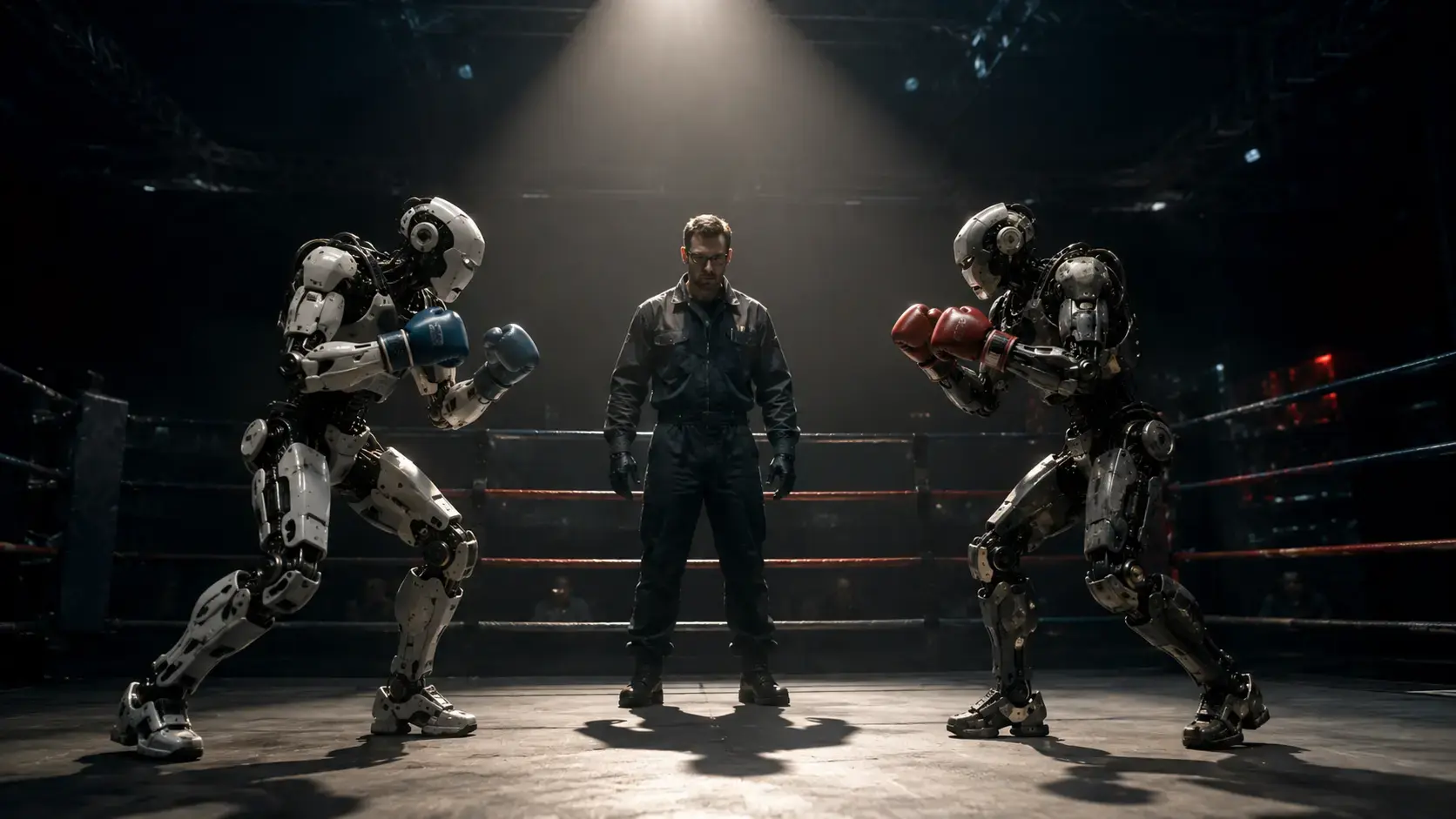
Boxing and martial arts events might seem like pure spectacle, but they are actually crash tests for durability and reflexes. When robots exchange controlled strikes, fall to the ground, and must get back up to continue, they are proving they can handle the physical chaos of real environments.
For investors, a robot that can survive contact, recover from falls, and keep functioning is a robot that won’t break down on day one in a factory. The boxing ring reveals which designs have robust hardware and which have control systems fast enough to prevent catastrophic joint failures.
For investors, a robot that can survive contact, recover from falls, and keep functioning is a robot that won’t break down on day one in a factory. The boxing ring reveals which designs have robust hardware and which have control systems fast enough to prevent catastrophic joint failures.
Work
The scenario-based events bridge the gap between stadium skills and real jobs. Robots compete at tasks like sorting medications in hospital simulations, cleaning hotel rooms, and handling materials in industrial scenarios.
These challenges expose a critical information gap: the sim-to-real bottleneck. A robot can run 100 meters in under 9 seconds but still struggle with a standard door handle. Referees at the 2025 games noted that opening and closing doors was the biggest obstacle for housekeeping robots. This is the honest truth that a humanoid robot competition reveals. Yet, these work events drive development in manipulation, tool use, and task planning - skills that will determine whether AI robots can actually augment human workers.
These challenges expose a critical information gap: the sim-to-real bottleneck. A robot can run 100 meters in under 9 seconds but still struggle with a standard door handle. Referees at the 2025 games noted that opening and closing doors was the biggest obstacle for housekeeping robots. This is the honest truth that a humanoid robot competition reveals. Yet, these work events drive development in manipulation, tool use, and task planning - skills that will determine whether AI robots can actually augment human workers.
The Names Behind the Machines: Robotics Domains on Ainame24
The games reward three fundamental capabilities: control systems that keep robots upright, brand identity that attracts talent, and the physics of motion powered by actuators and simulation. These are exactly the robotics domains showcased on Ainame24, where each name links to its official listing and represents a critical layer of the robotics stack.
HumanoidController.com
Every robot that finishes a race or successfully picks up an object relies on a control layer working flawlessly. HumanoidController.com represents this critical infrastructure - the "brain" and nervous system responsible for movement, balance, behavior, and human interaction.
This domain is ideal for companies building motion-control software, teleoperation platforms, or multi-robot orchestration systems. Whether it is programming a humanoid controller to maintain stability during a 1,500-meter race or coordinating multiple robots in a factory, this name carries immediate technical credibility and positions itself at the center of humanoid robot development.
This domain is ideal for companies building motion-control software, teleoperation platforms, or multi-robot orchestration systems. Whether it is programming a humanoid controller to maintain stability during a 1,500-meter race or coordinating multiple robots in a factory, this name carries immediate technical credibility and positions itself at the center of humanoid robot development.
Humoidx.com
In a field crowded with overly technical names, Humoidx.com stands out as a brandable, futuristic identity. The name blends "Humoid" (from Human + Humanoid) with "X" - the symbol of advanced technology, experimentation, and the unknown frontier. It is short, modern, easy to pronounce, and carries a distinct sci-fi character.
This domain is perfect for a humanoid startup launching its first commercial robot, an AI platform training next-generation humanoids, or a marketplace creating an ecosystem for humanoid technologies. In an industry where brand recognition attracts venture capital, Humoidx offers instant positioning as a cutting-edge player.
This domain is perfect for a humanoid startup launching its first commercial robot, an AI platform training next-generation humanoids, or a marketplace creating an ecosystem for humanoid technologies. In an industry where brand recognition attracts venture capital, Humoidx offers instant positioning as a cutting-edge player.
SimActuator.com
Behind every robot movement lies the physics of actuation. SimActuator.com occupies the critical technological layer between AI software and physical hardware, combining simulation ("Sim") with the mechanisms that convert control commands into movement ("Actuator").
This domain is ideally suited for companies building actuator simulation software, motor dynamics modeling, sim-to-real platforms, or digital twins. As the games demonstrate, the difference between simulated performance and real-world behavior can be dramatic. Modern robotics depends on accurate actuator models to train AI policies in simulation before deploying them on physical robots. SimActuator represents the infrastructure that closes the sim-to-real gap.
This domain is ideally suited for companies building actuator simulation software, motor dynamics modeling, sim-to-real platforms, or digital twins. As the games demonstrate, the difference between simulated performance and real-world behavior can be dramatic. Modern robotics depends on accurate actuator models to train AI policies in simulation before deploying them on physical robots. SimActuator represents the infrastructure that closes the sim-to-real gap.

What Robot Games Mean for Startups and Investors
The arena has become the ultimate benchmark. When 280 teams in 2025 grew to 666 teams in 2026, it signaled that these competitions are where serious players prove their technology. Investors watch closely: which teams finish the race, which robots catch fire, which companies win multiple events. Unitree’s dominance in 2025 immediately positioned it as a top-tier rival and attracted global attention.
For startups, the games offer visibility that would cost millions in traditional marketing. A robot that breaks a world record or wins a dramatic boxing match earns headlines in major tech and business publications. More importantly, the competitions reveal which categories of robotics are maturing and which still need breakthrough innovations.
Category-defining names gain attention fast. In a field where technical credibility matters, domains that clearly communicate their positioning become natural reference points for investors, partners, and customers. You can explore robotics and AI domain collections on Ainame24 to see how strategic naming aligns with emerging technology sectors.
For startups, the games offer visibility that would cost millions in traditional marketing. A robot that breaks a world record or wins a dramatic boxing match earns headlines in major tech and business publications. More importantly, the competitions reveal which categories of robotics are maturing and which still need breakthrough innovations.
Category-defining names gain attention fast. In a field where technical credibility matters, domains that clearly communicate their positioning become natural reference points for investors, partners, and customers. You can explore robotics and AI domain collections on Ainame24 to see how strategic naming aligns with emerging technology sectors.
The Future: From Stadiums to Factories and Homes
The skills learned in public will become products in private. Robots that master locomotion on stadium tracks will soon navigate warehouse floors and construction sites. Machines that recover from boxing falls will handle unexpected obstacles in homes and hospitals. Systems that sort medications in competition scenarios will work in real pharmacies.
The pipeline from games to deployment is already visible. Engineers note that structural reliability and liquid-cooling technology developed for marathon-running robots can transfer directly to industrial scenarios. The robots competing in Beijing didn’t just win races; they proved capabilities that will power commercial deployments.
What to watch next: autonomy levels increasing across more events, scenario-based challenges becoming more complex, and the gap between athletic performance and practical work narrowing. The robots that stumble on a Beijing track today are being refined daily. Within a few years, they won’t just be competing. They will be working.
The pipeline from games to deployment is already visible. Engineers note that structural reliability and liquid-cooling technology developed for marathon-running robots can transfer directly to industrial scenarios. The robots competing in Beijing didn’t just win races; they proved capabilities that will power commercial deployments.
What to watch next: autonomy levels increasing across more events, scenario-based challenges becoming more complex, and the gap between athletic performance and practical work narrowing. The robots that stumble on a Beijing track today are being refined daily. Within a few years, they won’t just be competing. They will be working.
Conclusion
The robot games in China are not a show. They are a rehearsal of the working future. The robots that stumble, fall, and get back up on a Beijing track today will carry boxes in warehouses tomorrow, assist elderly people in homes, and handle hazardous materials in factories. Each race, each boxing match, each failed attempt to open a door generates data that makes the next generation better.
For founders, investors, and engineers, the message is clear: embodied AI is moving from research to reality faster than most predicted. The stadium is the proving ground, and the lessons learned here will shape the robotics industry for decades. Follow the trend, watch the results, and explore the emerging infrastructure that will power the humanoid era.
For founders, investors, and engineers, the message is clear: embodied AI is moving from research to reality faster than most predicted. The stadium is the proving ground, and the lessons learned here will shape the robotics industry for decades. Follow the trend, watch the results, and explore the emerging infrastructure that will power the humanoid era.