
Long before the internet, a local business lived and died by a printed directory. If your name was easy to find in the yellow paper, the phone rang; if it wasn't, you stayed a secret. Then the web arrived, and the directory quietly became a domain: geo domains - names that weld a city to a service, like LosAngelesBeef.com - are the digital heirs of that yellow paper. Let's take a made-up example: a butcher in 1987 buys a bold Yellow Pages ad; his successor in 2026 buys the city-plus-service .com instead. Same instinct, new medium. Here is how that habit survived a century - and which geo domain names are still on the shelf.

What Is a Geo Domain? A Simple Definition
A geo domain is a domain name that combines a place - a city, a region, a landmark - with a service, product, or category. LosAngelesBeef.com, TheDubaiSalon.com, LondonMonthlyRental.com: the pattern reads itself. The name answers three questions at once - who (anyone in that city), what (the service), and where (the city itself).
It is the printed directory listing reborn as an address. A butcher once paid for a bold entry under "Meat - Los Angeles"; today the same instinct buys the .com. And because the format mirrors how people actually search - "city + service" is one of the oldest habits on the web - a city + service domain works as both a brand and a billboard. City domain names like these need no tagline: the name is the pitch.
It is the printed directory listing reborn as an address. A butcher once paid for a bold entry under "Meat - Los Angeles"; today the same instinct buys the .com. And because the format mirrors how people actually search - "city + service" is one of the oldest habits on the web - a city + service domain works as both a brand and a billboard. City domain names like these need no tagline: the name is the pitch.
From Yellow Pages to .com: A Short History of Local Naming
The habit starts with paper. As the industry legend goes, in 1883 a printer in Cheyenne, Wyoming, ran out of white paper midway through a telephone directory and finished the job with yellow stock. Readers loved finding businesses by trade, the "yellow pages" became the map of every town's commerce, and for a century, being easy to find in that book was the whole of local marketing.
Then the map went digital. On March 15, 1985, a Massachusetts computer company called Symbolics registered symbolics.com - the first .com in history. At the time it was a curiosity; only a handful of domains existed at all. But the idea of owning an address on the network had been planted.
By the mid-1990s, cities themselves started moving online. CitySearch, founded in 1995, was openly described as a Yellow Pages for the web - a directory of local businesses, now clickable. City-specific portals followed: Vegas.com launched in 1998 as one of the first destinations built entirely around a single city's name. The printed directory hadn't died; it had simply changed paper.
In the 2000s, investors noticed that city-plus-category names behaved like digital corner lots and quietly began collecting them. But the real explosion came with smartphones. By the 2010s, "near me" and "city + service" queries were growing several times faster than ordinary searches, according to Google's own data. Local SEO became a discipline of its own, and the old Yellow Pages instinct - be the obvious name in your town - turned out to be more valuable than ever. It had just moved into the search bar.
Then the map went digital. On March 15, 1985, a Massachusetts computer company called Symbolics registered symbolics.com - the first .com in history. At the time it was a curiosity; only a handful of domains existed at all. But the idea of owning an address on the network had been planted.
By the mid-1990s, cities themselves started moving online. CitySearch, founded in 1995, was openly described as a Yellow Pages for the web - a directory of local businesses, now clickable. City-specific portals followed: Vegas.com launched in 1998 as one of the first destinations built entirely around a single city's name. The printed directory hadn't died; it had simply changed paper.
In the 2000s, investors noticed that city-plus-category names behaved like digital corner lots and quietly began collecting them. But the real explosion came with smartphones. By the 2010s, "near me" and "city + service" queries were growing several times faster than ordinary searches, according to Google's own data. Local SEO became a discipline of its own, and the old Yellow Pages instinct - be the obvious name in your town - turned out to be more valuable than ever. It had just moved into the search bar.
Why City + Service Names Still Win in 2026
The format is a century old and still outperforms clever branding for local trades. Here is why:
- Instant local intent. The name is the search query. Someone typing "London monthly rental" has already met LondonMonthlyRental.com halfway.
- Zero explanation needed. No marketing budget required to decode the name - it says what it sells and where it sells it.
- A strong local SEO signal. A local SEO domain that repeats a real search phrase earns relevance before a single page of content is written.
- Trust and memorability. Locals read it as "ours"; tourists and newcomers read it as "established." Both feel safer clicking.
- Free advertising everywhere. On a van, a uniform, a shop sign or a radio mention, the city name does half the selling for you.
- Absolute scarcity. There will only ever be one LosAngelesBeef.com. Whoever owns the phrase owns the corner lot.
The Anatomy of a Strong Geo Domain
Not every city-plus-word combination is a winner. Experienced investors grade candidates against a short checklist:
- The city, spelled the way locals type it. "LosAngeles," not "LA" or "Los-Angeles" - match the search bar, not the postcard.
- One clear service word. Beef, salon, rental. One trade, one promise, no ambiguity.
- .com first. It remains the extension people trust and type by default.
- No hyphens, no numbers. Both read as a compromise and get dropped when the name is spoken aloud.
- Singular vs plural, tested. "Rental" and "rentals" attract slightly different search habits — check real usage before you commit.
- Room to grow inside the niche. "Beef" can cover steaks, delivery boxes, and exports; a narrower word caps your future.

Real Examples: Geo Domains on Ainame24
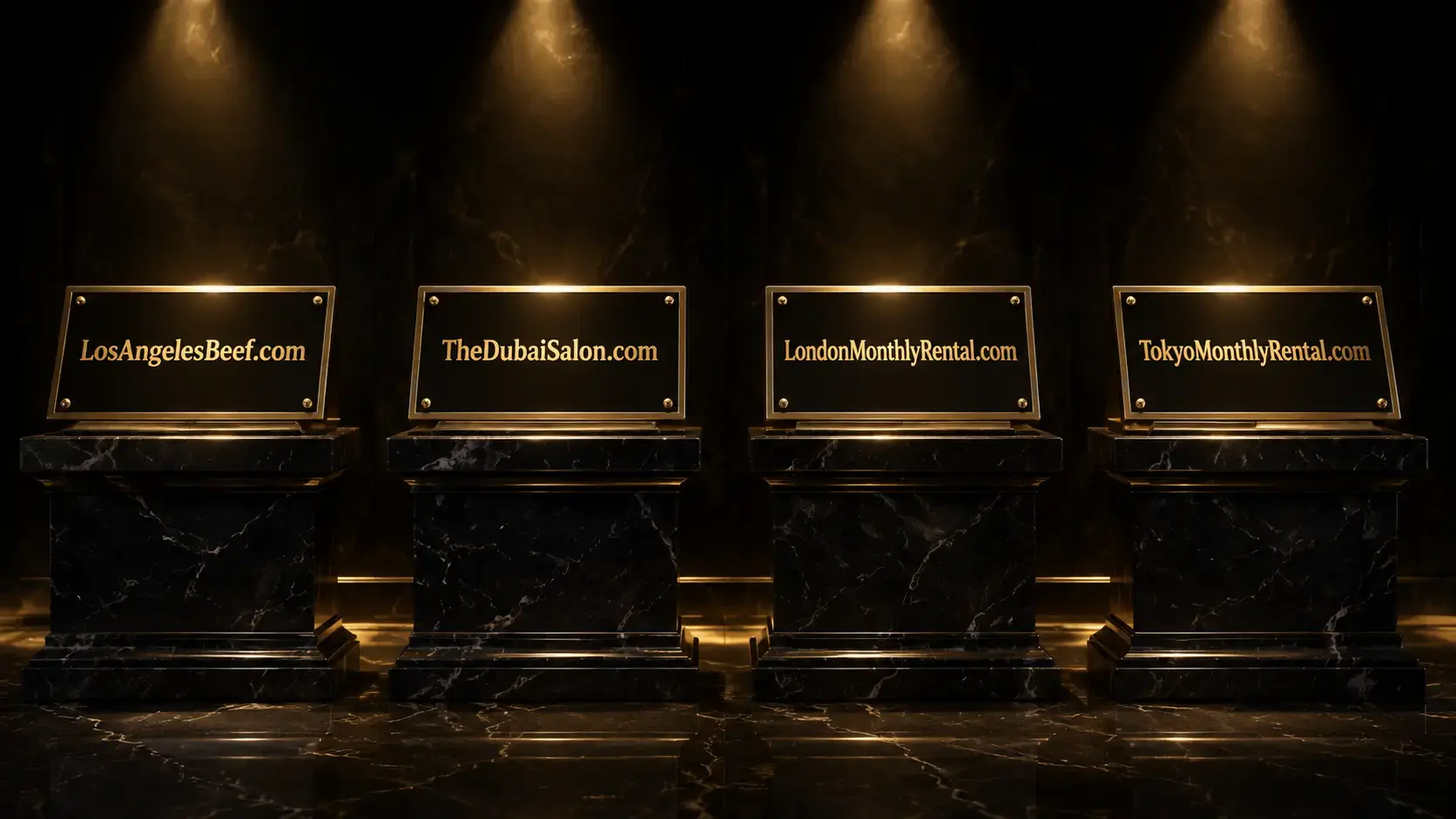
Enough theory - let's walk the shelf. Here are four geo domains currently listed on Ainame24, chosen for the range of cities and trades they cover. Each links to its showcase page with the full story and the official marketplace listing.
LosAngelesBeef.com
Two words, and the whole brand is visible: premium meat with a California accent. The showcase page describes it as sunshine, lifestyle, and top-grade steak in one name - appetizing, memorable, and made for packaging.
Ideal fits include a premium beef delivery service, dry-aged steak subscriptions, an online shop for rare cuts, Angus and Wagyu brands, corporate gourmet gifts, or a virtual steakhouse. In a city that turned food into culture, the name already sounds famous.
Ideal fits include a premium beef delivery service, dry-aged steak subscriptions, an online shop for rare cuts, Angus and Wagyu brands, corporate gourmet gifts, or a virtual steakhouse. In a city that turned food into culture, the name already sounds famous.
TheDubaiSalon.com
The small word "The" does heavy lifting here: it turns a description into an institution - not a salon in Dubai, butthe Dubai salon. The name radiates the city's signature mix of luxury, glamour, and world-class service.
Its page positions it as a flagship beauty salon or luxury salon network, a VIP booking platform, a bridal and event beauty studio, or a high-end skincare brand. For affluent international clients, the name reads as a promise.
Its page positions it as a flagship beauty salon or luxury salon network, a VIP booking platform, a bridal and event beauty studio, or a high-end skincare brand. For affluent international clients, the name reads as a promise.
LondonMonthlyRental.com
This is the directory instinct in its purest modern form: the name is exactly what people type - "monthly rentals in London." No metaphor, no decoding, just a direct, high-conversion promise aimed at expats, students, and companies.
The page points it at relocation platforms, mid-term furnished apartments, aggregators for landlords, and apps for digital nomads. In one of the world's most expensive rental markets, clarity is the entire product.
The page points it at relocation platforms, mid-term furnished apartments, aggregators for landlords, and apps for digital nomads. In one of the world's most expensive rental markets, clarity is the entire product.
TokyoMonthlyRental.com
The same formula, a different world city. Tokyo is one of the most dynamic - and most intimidating - rental markets on earth for foreigners, and a name that says exactly what it offers works like a handrail in the crowd.
Ideal for relocation services to Japan, furnished mid-term apartments, corporate housing, or a nomad-focused rental app. Professional, trustworthy, and instantly searchable in English - the language international tenants actually type.
Ideal for relocation services to Japan, furnished mid-term apartments, corporate housing, or a nomad-focused rental app. Professional, trustworthy, and instantly searchable in English - the language international tenants actually type.
Four cities, three trades, one pattern: the name does the marketing before the website even loads.
Where to Buy a Geo Domain Safely
When you decide to buy a geo domain, treat it like buying property: use a verified marketplace and an escrow service that releases the money only after the domain is legally transferred to you. The boring middleman is the safest middleman.
Re-check trademarks - city names are free for everyone, but specific combinations can still collide with local brands - and always confirm the official sales channel. Every showcase page on Ainame24 links its domain to an official Afternic or Sedo listing, so you can verify before you commit. If you're comparing geo domains for sale today, browse our geo domain collection and see which city-plus-service names are still unclaimed.
Re-check trademarks - city names are free for everyone, but specific combinations can still collide with local brands - and always confirm the official sales channel. Every showcase page on Ainame24 links its domain to an official Afternic or Sedo listing, so you can verify before you commit. If you're comparing geo domains for sale today, browse our geo domain collection and see which city-plus-service names are still unclaimed.
The printed directory is gone, but the habit it trained never died. People still search "city + service" - they just type it into a search bar instead of flipping yellow paper. A geo domain is that century-old instinct, compressed into one address: obvious, local, and impossible to misunderstand. The best city-plus-service names are still on the shelf today; tomorrow, a competitor may own your exact phrase. Say your city and your trade out loud - then go claim the .com at Ainame24.