
The word "startup" feels timeless, yet it is younger than most founders assume - and the habit of fighting over a .com is younger still. For most of business history, you invented a name first and worried about the address later. Today, startup domain names are checked before the logo is sketched, and the name-plus-domain pair is the first line of marketing. Let's take a made-up example: a founder in 1997 writes the company name on a napkin and discovers the domain months later; a founder in 2026 opens a domain search before the napkin. Same dream, opposite order. Here is how that quiet flip happened - and which brandable startup .coms are still on the shelf.

A Short History of the Startup: From Garages to the Cloud
Every industry has a founding myth, and Silicon Valley's is the garage. Hewlett and Packard's first workshop was a one-car garage on Addison Avenue in Palo Alto, today remembered as the "Birthplace of Silicon Valley." When Apple assembled its first computers in the Jobs family garage in Los Altos in 1976, the image was set forever: big companies begin in small rooms.
The ecosystem itself grew the same way - by splitting. In 1957, eight employees walked out of Shockley Semiconductor and founded Fairchild Semiconductor; then they kept leaving to found more companies. Within two decades, those eight had spawned around sixty-five new enterprises, a startup avalanche that turned a Stanford research park into the world's company factory.
The word "startup" went mainstream only when the web did. Tim Berners-Lee's World Wide Web was born at CERN around 1989–90, commercial internet providers appeared at the same time, and in 1995 the last restrictions on commercial traffic were lifted. What followed was the dot-com boom: between 1995 and its peak on March 10, 2000, the Nasdaq multiplied several times over, and investors happily funded any company whose name carried a ".com" suffix.
The bubble burst, but the habits survived. Web 2.0 taught a generation to trust coined words like Flickr and Tumblr; the iPhone in 2007 and the app economy that followed moved the brand onto a phone screen. And today's AI wave accelerated everything - by one industry count, nearly one in four new startups now describes itself as an AI company. Each one still begins the same way: with a name, and a domain.
The ecosystem itself grew the same way - by splitting. In 1957, eight employees walked out of Shockley Semiconductor and founded Fairchild Semiconductor; then they kept leaving to found more companies. Within two decades, those eight had spawned around sixty-five new enterprises, a startup avalanche that turned a Stanford research park into the world's company factory.
The word "startup" went mainstream only when the web did. Tim Berners-Lee's World Wide Web was born at CERN around 1989–90, commercial internet providers appeared at the same time, and in 1995 the last restrictions on commercial traffic were lifted. What followed was the dot-com boom: between 1995 and its peak on March 10, 2000, the Nasdaq multiplied several times over, and investors happily funded any company whose name carried a ".com" suffix.
The bubble burst, but the habits survived. Web 2.0 taught a generation to trust coined words like Flickr and Tumblr; the iPhone in 2007 and the app economy that followed moved the brand onto a phone screen. And today's AI wave accelerated everything - by one industry count, nearly one in four new startups now describes itself as an AI company. Each one still begins the same way: with a name, and a domain.
Name First, Domain Later: How Founders Used to Think
For most of business history, a name was designed for the offline world: a sign above the door, a line in the phone book, a word spoken across a counter. The address - street, then phone number, then fax - was attached afterwards. When websites appeared, the domain joined that list of afterthoughts, somewhere between the fax number and the company stamp.
Picture a fictional founder in 1998. She loves "Brightpath Consulting," discovers brightpath.com is taken, and shrugs: bright-path-consulting.com goes on the business card. Nobody panics, because the website is a brochure, not the business. Customers still find her through the yellow pages, not a typed URL. A hyphen is an inconvenience, not a brand wound.
That ordering - name first, domain later, and only if needed - survived well into the 2000s. Startup naming was about meaning and story; the domain was logistics. It was the last era when a founder could fall in love with a word before checking whether the internet agreed.
Picture a fictional founder in 1998. She loves "Brightpath Consulting," discovers brightpath.com is taken, and shrugs: bright-path-consulting.com goes on the business card. Nobody panics, because the website is a brochure, not the business. Customers still find her through the yellow pages, not a typed URL. A hyphen is an inconvenience, not a brand wound.
That ordering - name first, domain later, and only if needed - survived well into the 2000s. Startup naming was about meaning and story; the domain was logistics. It was the last era when a founder could fall in love with a word before checking whether the internet agreed.
The Flip: When the Domain Became the Brand
The reversal happened gradually, then all at once. As discovery, sales, and support moved online, the domain stopped being a brochure and became the front door. And the dot-com era had already planted the seed: investors of the late 1990s were eager to fund any company whose name carried an internet prefix or a ".com" suffix - the address was part of the pitch before the product existed.
Today the order is fully inverted. A domain name for startup teams is checked before the name is final, because it will appear in the pitch deck, the app store listing, the investor's inbox, and the customer's muscle memory. The pair "name + .com" is marketing from day one: it is typed, shared, remembered, and trusted. A clean .com quietly says "we are real."
This is why brandable startup domain names became the default strategy. The dictionary is exhausted - short real words are registered or priced like real estate - but the imagination is not. Invented, short, pronounceable words are the realistic path to owning, not renting, a clean .com. Startup naming finally caught up with a simple truth: on the internet, the address is the brand.
Today the order is fully inverted. A domain name for startup teams is checked before the name is final, because it will appear in the pitch deck, the app store listing, the investor's inbox, and the customer's muscle memory. The pair "name + .com" is marketing from day one: it is typed, shared, remembered, and trusted. A clean .com quietly says "we are real."
This is why brandable startup domain names became the default strategy. The dictionary is exhausted - short real words are registered or priced like real estate - but the imagination is not. Invented, short, pronounceable words are the realistic path to owning, not renting, a clean .com. Startup naming finally caught up with a simple truth: on the internet, the address is the brand.
What Makes a Strong Startup Domain in 2026
Thirty years of trial and error produced a surprisingly stable checklist. When founders hunt for the best domain for startup ideas today, they tend to grade every candidate against the same rules:
- Short and pronounceable - five to eight letters that survive a hurried introduction.
- .com first - it remains the extension people type by default and trust by habit.
- Brandable over descriptive - an invented word grows with you; a description pins you down.
- The radio test - heard once, it can be spelled correctly; no "is that with a K?" moments.
- No hyphens, no numbers - both read as compromise and get dropped in conversation anyway.
- Trademark and handle check - a clean search and matching social handles before any payment.
- Room to grow - a name that still fits if the startup changes categories, markets, or planets.
A startup domain that passes all seven is rare - and that rarity is exactly why the good ones get snapped up early.

Real Examples: Startup Domains on Ainame24
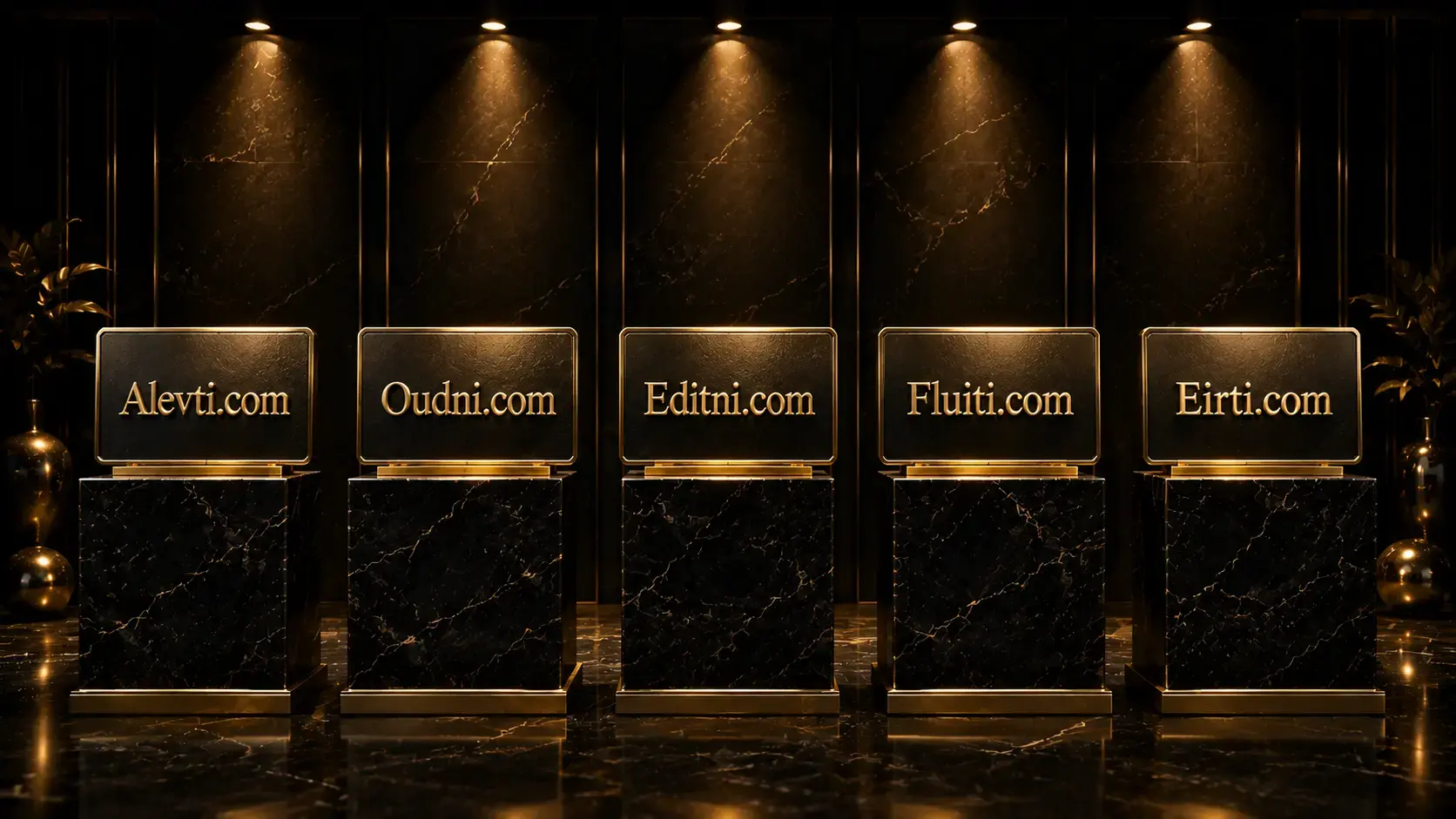
History is more digestible with real names in front of you. Here are five brandable startup domains currently listed on Ainame24, chosen for the different futures they imagine. Each one links to its showcase page, with the full story and the official marketplace listing.
Alevti.com
Alevti borrows its lift from "elevate" - a soft "Alev" opening that whispers growth, uplift, and improvement, finished with a tech-friendly "-ti." It sounds positive, energetic, and quietly ambitious.
Its showcase page points it at everything that climbs: personal-growth platforms, productivity AI, online education, fitness apps, and growth-focused fintech. A name for a brand whose whole promise is "up."
Its showcase page points it at everything that climbs: personal-growth platforms, productivity AI, online education, fitness apps, and growth-focused fintech. A name for a brand whose whole promise is "up."
Oudni.com
Oudni takes its melody from the oud, the storied string instrument of the Middle East. Five letters, elegant and international, it fuses art, harmony, and a hint of luxury with a modern "-ni" ending.
The page imagines it in music and audio: creation and editing platforms, AI sound generation, meditation and sound-therapy apps, podcast tools, and premium audio hardware. A name that literally sounds like music.
The page imagines it in music and audio: creation and editing platforms, AI sound generation, meditation and sound-therapy apps, podcast tools, and premium audio hardware. A name that literally sounds like music.
Editni.com
Editni puts the craft upfront: "edit" plus a light "-ni," a six-letter name that instantly signals creation, revision, and polish. It feels like a tool professionals would trust with their work.
Unsurprisingly, its page positions it across the creator economy: photo and video editors, AI-powered content tools, collaborative document platforms, podcast editing, and SaaS for marketers. A name for the age of endless drafts.
Unsurprisingly, its page positions it across the creator economy: photo and video editors, AI-powered content tools, collaborative document platforms, podcast editing, and SaaS for marketers. A name for the age of endless drafts.
Fluiti.com
Fluiti flows. Built on "fluid" with a soft "-ti" ending, it evokes smoothness, speed, and adaptability - the feeling of software that never makes you wait.
The page steers it toward workflow: video editing with seamless transitions, task and project management, fintech payments, workflow automation, and real-time analytics. A name that promises friction, nowhere.
The page steers it toward workflow: video editing with seamless transitions, task and project management, fintech payments, workflow automation, and real-time analytics. A name that promises friction, nowhere.
Eirti.com
Eirti is the purest kind of brandable: five letters, no dictionary baggage, no single language claiming it. A blank canvas with a clean, technological feel - the name becomes exactly what the company pours into it.
Its page keeps every door open: SaaS and AI, fintech, e-commerce, gaming, EdTech, enterprise tools. The classic "empty vessel" strategy - the same logic that made words like Kodak and Spotify ownable everywhere.
Its page keeps every door open: SaaS and AI, fintech, e-commerce, gaming, EdTech, enterprise tools. The classic "empty vessel" strategy - the same logic that made words like Kodak and Spotify ownable everywhere.
Five names, five moods: uplift, melody, craft, flow, and pure potential. That spread is the point - a startup domain should set the emotional key before the first line of code ships.
Where to Buy a Startup Domain Safely
When you decide to buy a startup domain, keep the purchase as disciplined as the naming. Use verified marketplaces and escrow services that hold the money until the domain is legally transferred - the boring middleman is the safest middleman.
Re-check the trademark landscape before paying, even for coined words, and always confirm the sales channel. Every showcase page on Ainame24 links its domain to an official Afternic or Sedo listing, so you can verify where and how the name is sold before committing.
If you are comparing startup domain names for sale right now, browse our startup domain collection and shortlist the ones that pass your radio test.
Re-check the trademark landscape before paying, even for coined words, and always confirm the sales channel. Every showcase page on Ainame24 links its domain to an official Afternic or Sedo listing, so you can verify where and how the name is sold before committing.
If you are comparing startup domain names for sale right now, browse our startup domain collection and shortlist the ones that pass your radio test.
Thirty years ago the domain was an afterthought printed under the logo; today it is the first line of marketing and the first slide investors read. The garages are now cloud accounts, but the founding ritual survives: a name, an address, a bet on the future. The best brandable names are still on the shelf - for now. Say them out loud, check the handles, and claim the one that sounds like your future. The right .com is waiting. Start at Ainame24.